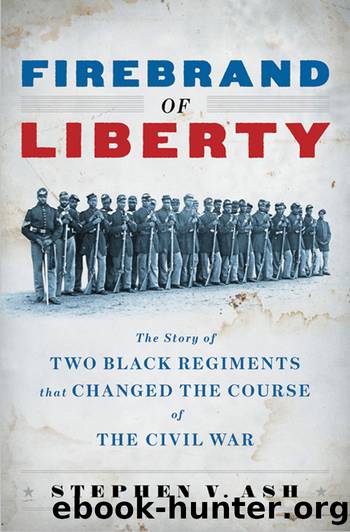
Firebrand of Liberty by Stephen V. Ash
Author:Stephen V. Ash
Language: eng
Format: epub
ISBN: 9780393069907
Publisher: W. W. Norton & Company
Chapter Seven
JACKSONVILLE AND THE WEST BANK
MARCH 27â29
SOON AFTER RECEIVING GENERAL HUNTERâS ORDER recalling the expedition, Colonel Rust convened a meeting of army and navy officers to discuss it. The mood at this conference was a mixture of shock, disbelief, and outrage. The order gave no reason for the recall, and the assembled officers were at a loss to understand it. The simplest answerâthat Hunter needed every available unit in the department for his imminent campaign against Charlestonâsatisfied none of them, for they all knew that he had been planning that campaign ever since he returned to departmental command in January. Why authorize the black regiments to undertake the St. Johnâs expedition and subsequently send reinforcements if those troops could not be spared? Higginson ascribed the recall to Hunterâs impulsiveness and cited it as yet another instance of the lack of direction in the Union high command that had long impeded the war effort. Others wondered seriously if Hunter was mentally unbalanced.1
While this meeting was going on or very soon after, the John Adams returned from Fernandina. Aboard were not only Lyman Stickney, coal and other supplies for the expeditionary force, and merchandise for Stickneyâs store but also some reinforcements that the tax commissioner had wheedled from Colonel Hawley, a field piece with its crew and twenty-five infantrymen of the 7th Connecticut. Informed of the recall order, Stickney was aghast. He urged that its execution be postponed while someone went to Hilton Head to plead with Hunter to revoke it; he would gladly go himself, he said. Some of the officers liked this idea, but in the end it was decided that Hunterâs commandment was peremptory and admitted of no delay.2
Stickney was distraught at this turn of events, which so abruptly ended his dream of striking it rich in Florida. Higginson too was sickened by Hunterâs order. âJust as our defences are complete & all in order for the transfer of part of our forces up river,â he wrote in his journal, â. . . we are ordered away. . . . The possession of this place gives the key to Florida, & the present garrison can hold it & spare us to go up river and yet we must go [back]. . . . It is the first time I have been thoroughly subjected to that uncertainty of counsel which has been the bane of the war; it [has] defeated us in this case, just in the hour of success.â3
That success included not just the manifest achievements and potential triumphs of the black troops in Florida but also the news of the expedition that was spreading throughout the country. As Higginson surely knew, the invasion of the south Atlantic mainland by black regiments had by now grabbed the attention not only of the South but also of the North. Rufus Saxton had proved an energetic publicist. He had followed up his initial message to the secretary of war, sent on March 6 as the expeditionary force was leaving Port Royal,
Download
This site does not store any files on its server. We only index and link to content provided by other sites. Please contact the content providers to delete copyright contents if any and email us, we'll remove relevant links or contents immediately.
| Africa | Americas |
| Arctic & Antarctica | Asia |
| Australia & Oceania | Europe |
| Middle East | Russia |
| United States | World |
| Ancient Civilizations | Military |
| Historical Study & Educational Resources |
The Dawn of Everything by David Graeber & David Wengrow(1707)
The Bomber Mafia by Malcolm Gladwell(1623)
Facing the Mountain by Daniel James Brown(1553)
Submerged Prehistory by Benjamin Jonathan; & Clive Bonsall & Catriona Pickard & Anders Fischer(1455)
Wandering in Strange Lands by Morgan Jerkins(1430)
Tip Top by Bill James(1416)
Driving While Brown: Sheriff Joe Arpaio Versus the Latino Resistance by Terry Greene Sterling & Jude Joffe-Block(1376)
Red Roulette : An Insider's Story of Wealth, Power, Corruption, and Vengeance in Today's China (9781982156176) by Shum Desmond(1359)
Evil Geniuses: The Unmaking of America: A Recent History by Kurt Andersen(1354)
The Way of Fire and Ice: The Living Tradition of Norse Paganism by Ryan Smith(1336)
American Kompromat by Craig Unger(1315)
F*cking History by The Captain(1304)
It Was All a Lie by Stuart Stevens;(1300)
American Dreams by Unknown(1286)
Treasure Islands: Tax Havens and the Men who Stole the World by Nicholas Shaxson(1274)
Evil Geniuses by Kurt Andersen(1257)
White House Inc. by Dan Alexander(1212)
The First Conspiracy by Brad Meltzer & Josh Mensch(1174)
The Fifteen Biggest Lies about the Economy: And Everything Else the Right Doesn't Want You to Know about Taxes, Jobs, and Corporate America by Joshua Holland(1126)
